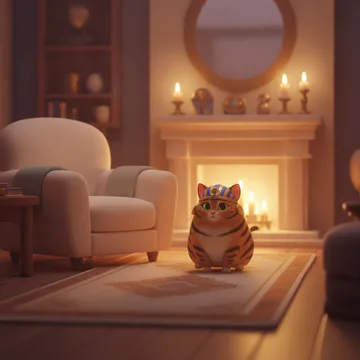
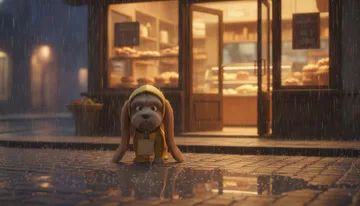
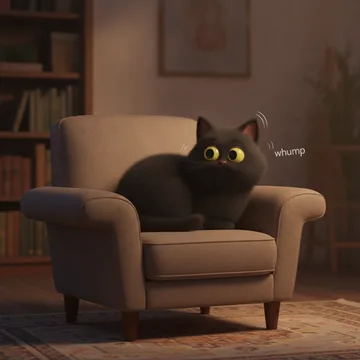
Winifred was a tabby cat who lived in the bakery on Hollow Lane. Every night, when the last loaf was baked and the ovens clicked off, she climbed to her shelf between the sourdough loaves and settled in. Flour dust. Warm wood. The faint sharp smell of yeast. Everything exactly right.
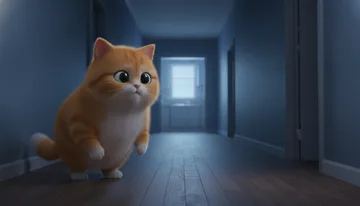
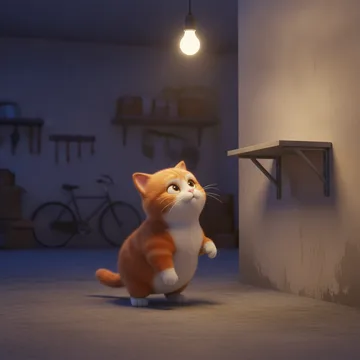
Tonight, she stopped. One paw still raised. Nostrils wide. Something was wrong with the smell. Not bread-wrong. Not flour-wrong. Something small and alive had been on her shelf. Winifred's whiskers twitched once, slowly. She lowered her paw. She dropped to the floor. Sniff, sniff, sniff. The trail began right there at the foot of the shelf, pressed into a scatter of spilled flour — tiny pawprints, barely bigger than raisins, leading away into the dark.
Winifred followed them past the cooling racks, where the baguettes ticked quietly as they cooled. She moved low and deliberate, her nose an inch from the floor. The pawprints turned left. Then right. One of them had smeared, as if something had skidded and kept going in a hurry. She squeezed behind the tall bread baskets. It was dark back there, and smelled of old cane and rye. Her ears swiveled left. Then right. A faint rustling — like someone rearranging themselves inside something small. Winifred sat very still and listened. Then she followed the sound.
The bread tins were stacked by the back wall in a long row. All of them upside down. Except one. Sniff, sniff, sniff. The smell was strongest here — warm and new and slightly like damp grass, which was not a bakery smell at all. Winifred looked into the tin. Two very round eyes blinked back at her from the dark inside. Orange ears. A nose like a pink seed. A kitten, barely bigger than a dinner roll, who had crawled in through a gap in the skirting board and made herself a nest using a scrap of brown paper because — as far as Winifred could tell — she had decided the tin looked exactly like a bed. The kitten sneezed. A small puff of flour came up from the paper. The kitten looked extremely pleased with herself.
Winifred sat back. She considered this for a long moment. A bread tin was not, in fact, a bad idea. But the paper was crinkly, and the tin was metal, and metal gets cold by midnight. Winifred knew this. She was a professional. She crossed to the rye loaves, where a folded cloth — the kind the baker used under hot trays — had been left on the lower shelf. She hooked it with one deliberate paw and dragged it down. She nudged it into place in the corner beside the rye, smoothing it flat with three careful pushes. The kitten watched all of this with enormous seriousness, as if taking notes. Winifred looked at the cloth. She looked at the kitten. She blinked once, slowly. The kitten stepped out of the tin, walked across the floor in a slightly wobbly line, and climbed onto the cloth. She turned around twice — which was unnecessary, but she was new — and folded herself down.
Her name, it turned out, was Pip. Winifred did not know this yet. She would find out in the morning. For now, she climbed back to her own shelf, tucked herself between the sourdough loaves, and breathed in. Flour. Warm wood. Yeast. And underneath it all, the faint damp-grass smell of Pip — which was already beginning to belong. Winifred's whiskers went still. She blinked once, slowly, at the dark bakery. Every loaf in its place. Case closed.