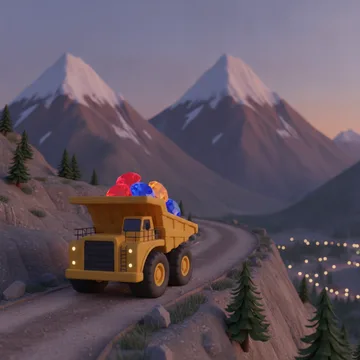
Otis was a big, broad-shouldered truck with a flatbed that could rise and fall like a slow, steady breath — up with a whirr, down with a hiss. That was his job. That was his gift. And today was the biggest day of the whole year.
It was the Summer Festival, and Otis carried the swan.
The swan was enormous. It was rainbow-sequined from beak to tail, every feather a different color, and when the morning sun hit it, the whole float blazed like a pile of scattered coins. Otis felt the weight of it settle on his flatbed — solid, sparkling, magnificent. He rumbled his engine twice, just to feel ready.
The parade began. Music played. Balloons — yellow, green, pink — bounced above the crowd. Children pressed against the rope barriers, pointing and laughing, and Otis rolled forward with his chin up, carrying that blazing swan through every cheer. Confetti drifted past his windshield like tiny bits of rainbow.
He was so proud he could hardly stand it.
Then came Cobbler's Corner.
The old stone arch sat right across the road, low and stubborn, the way old things sometimes are. Otis saw it early and slowed down. He measured it with his eyes. He measured the swan. His stomach dropped like a heavy wrench falling onto concrete.
The left wingtip. It was too wide. It would not fit.
The crowd went quiet. The confetti cannons stood ready on the other side, waiting. Otis could not go forward. He could not reverse — the whole parade was stacked behind him, trombones and all. He could not go around. There was only one street. There was only one arch.
*Whirr and hiss. Whirr and hiss.* Otis thought carefully.
The platform. If he lowered the platform — slowly, just three inches, just enough — the wing would drop below the lip of the stone. Not yanking, not rushing. Just easing, the way you ease a stubborn lid off a jar. He reached for the hydraulic controls and began.
The platform tilted with a long, low mechanical groan. The sequins shivered. The swan wobbled. The crowd held its breath. Inch by careful inch, the wingtip dropped — just below the arch's edge, just barely, just enough.
And then something shot out of the swan's neck.
A pigeon. Small, grey, absolutely furious, with one feather sticking straight up from the top of his head like a tiny flag of outrage. His name, though nobody knew it yet, was Bo. He had been nesting in the hollow neck since breakfast, and he had opinions about being tilted.
Bo landed on the arch. He glared at the crowd. He glared at Otis. He ruffled every feather he had.
The crowd exploded laughing — then cheering — as the wingtip slid clean under the arch with a soft stone scrape and came out the other side, glittering in full sun. The confetti cannons went off all at once. Bo flew away in a huff. And Otis rolled through.
*Whirr and hiss. Whirr and hiss.* The platform rose back to full height, and the swan blazed above the street, rainbow and magnificent, right where it belonged.
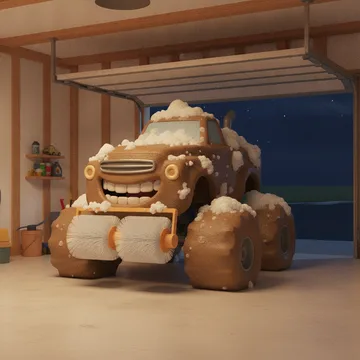
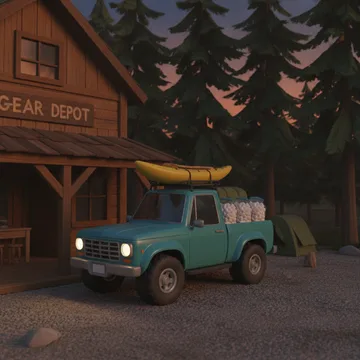
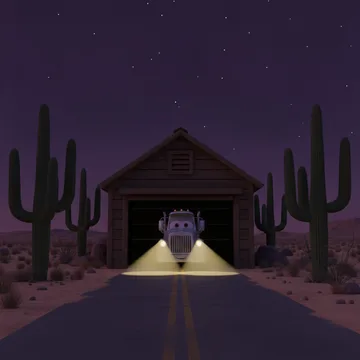
That night, Otis pulled into the depot. The crowds were gone. The music was gone. The confetti was swept into piles somewhere far away. He parked beside the swan, cut his engine, and let the hydraulics sigh all the way down to still.
The depot was dark and cool, and quiet except for the slow tick-tick-tick of his engine cooling in the dark — and the swan beside him, gleaming very softly, one sequin catching the last slip of light through the high window.