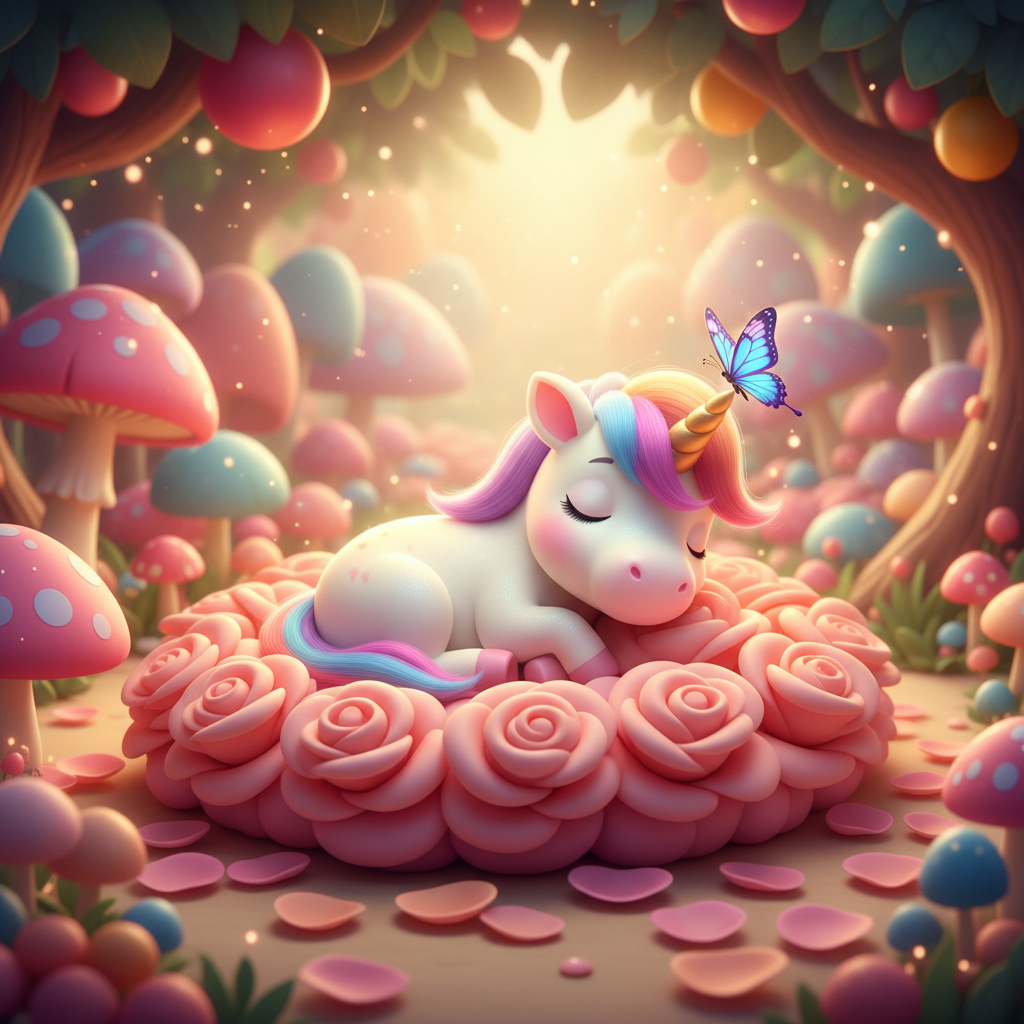
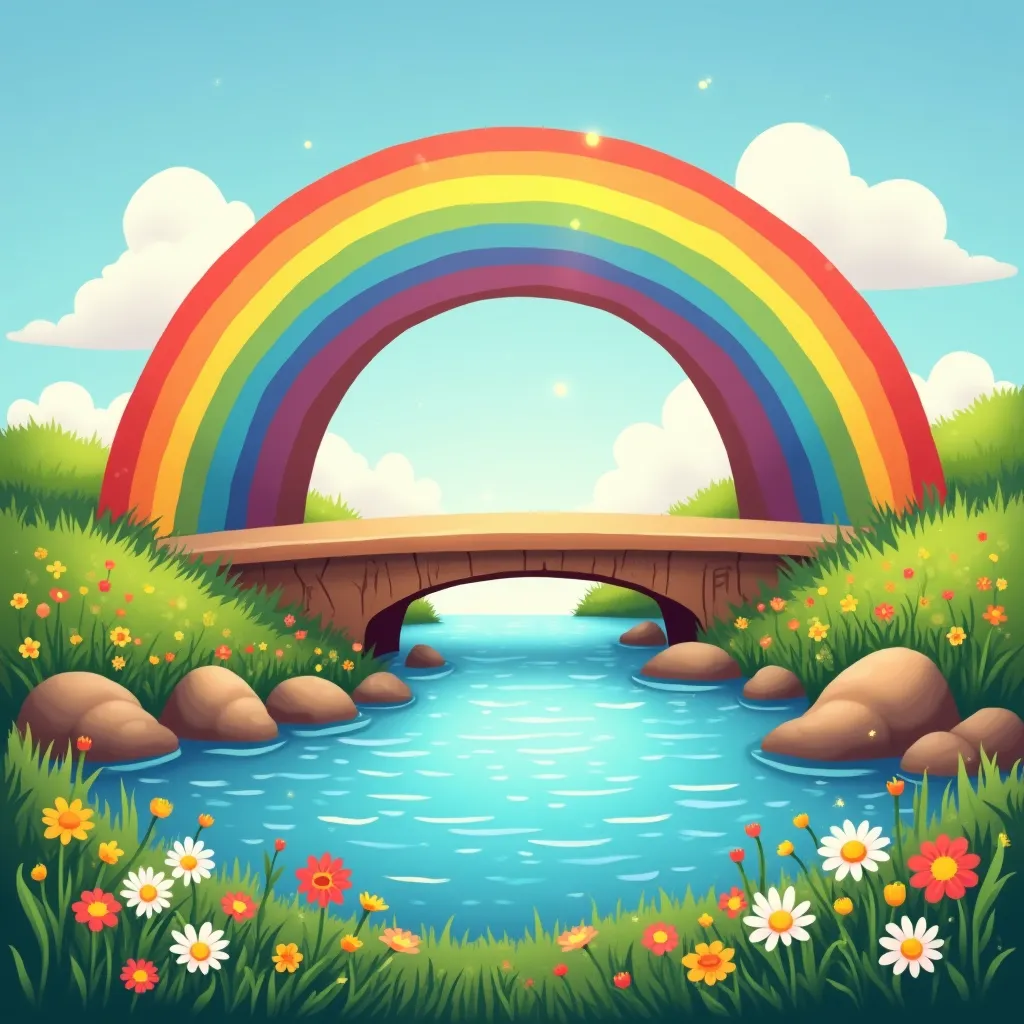
The rainbow stream was still.
Lyra stood at the bank and looked. The colours were all there — red, orange, yellow, green, blue, indigo, violet — but they sat in flat, separate stripes, like ribbons pressed under a heavy book. The water did not move them. The forest around her felt a little like a held breath.
She knew what the stream needed. Upstream, seven petal-pools fed it colour — each one a different flower, each one dropping soft petals into the current to set it swirling. One of them had stopped. She would go and find it.
Rustle. Crinkle. Swish.
That was Lyra, moving through the forest. Her mane was very long — it swept behind her like a slow silver tide — and the forest floor was full of things for it to collect. A dry leaf. A small twig. Half a pine cone. The forest knew when Lyra was coming.
She did not mind. She stepped carefully over a root, and her mane swept up a little pile of moss, and she kept walking. The air smelled of earth and cool bark and something faintly sweet from far away.
Then she heard a very small, very cross sound.
"Hm. Hmph. Hm."
She stopped. Something in her mane was moving. She turned her head slowly and looked back — and there, tangled in a loop of silver hair, was a beetle. Round and dark as a plum stone, with six legs going in six different directions.
"I," said the beetle, "have been trying to cross that mud for a very long time."
His name was Cob. And once Lyra had carefully set him on top of her nose — which he seemed to find perfectly acceptable — he told her that he knew exactly which pool had stopped. The indigo one. He had walked past it that morning and seen the trouble himself: a smooth stone, rolled right across the opening, with indigo petals piling up behind it, going nowhere.
Rustle. Crinkle. Swish. They went together through the trees.
The indigo pool was small and still, tucked beneath a wide fern. The petals were a deep, dusty blue-purple, heaped up soft as a pillow against the stone. The stone was round and grey and looked very settled, the way stones do when they have been somewhere a while.
Lyra thought about nudging it with her nose. She looked at the mud. She looked at her mane. She thought about being stuck there until spring.
Instead, she breathed.
One long, slow, careful breath — not a huff, not a blow, just the quietest steady exhale, the kind that fogs cold glass. The stone wobbled. She breathed again. The stone tipped. And the indigo petals — all of them at once — tumbled into the water with a soft, whispering rush.
Lyra turned to the stream.
The colours were moving. All seven of them, twisting and threading together — red into orange, orange into yellow, yellow curling into green, green deepening into blue, blue sliding into indigo, indigo softening into violet. The water caught the last of the light and gave it back in ribbons.
She lay down at the bank, her mane spreading around her across the grass, still holding its two leaves and its small piece of moss. Her chin rested on the cool earth. Upstream, a single indigo petal came turning slowly around the bend, and she watched it all the way past.